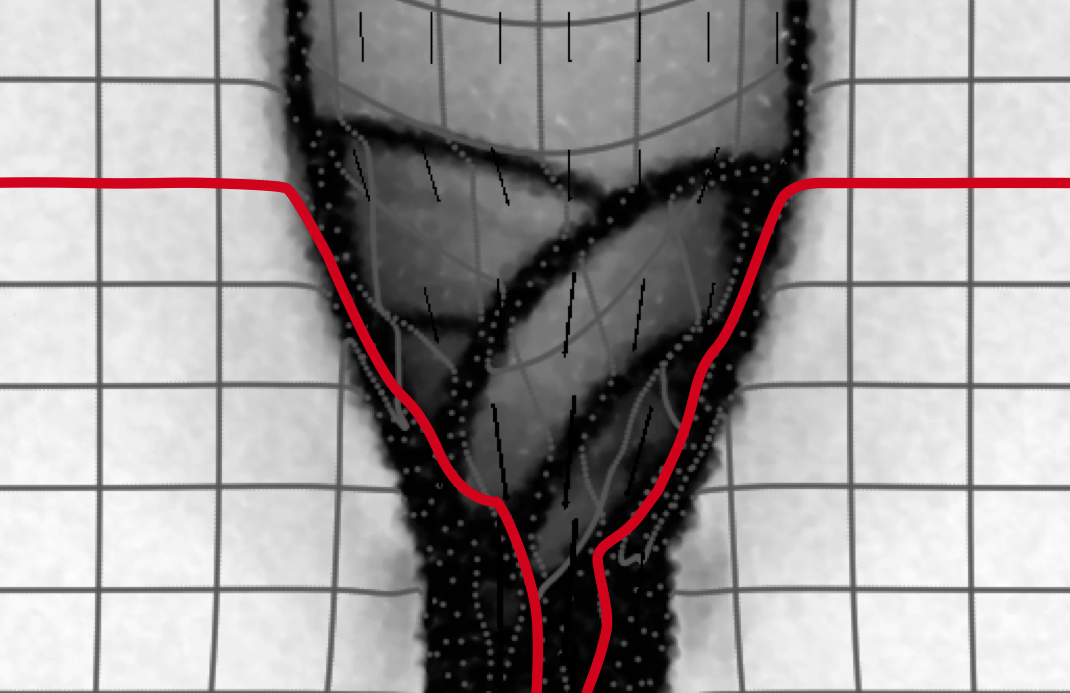
In honour of Hans Mühlhaus’ 70th birthday this month, here are some shear band simulations made with Underworld. We are investigating the role of dilatancy in the geometry of the shear bands for a box of material when a small trapdoor is opened.
The extent to which large-scale deformation is needed to release material through the trapdoor depends on how much the material dilates when shear bands form. This is a taster:
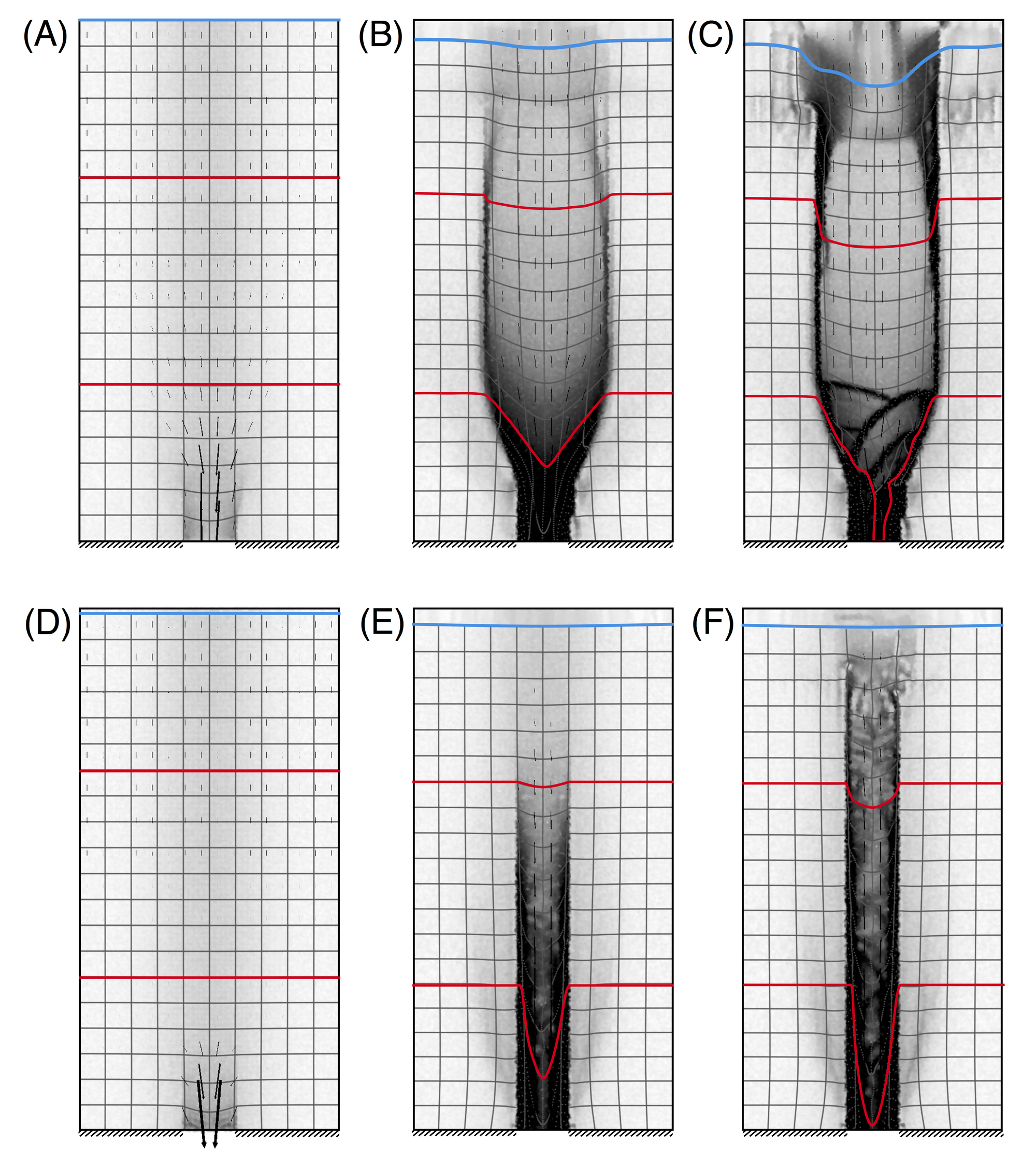
Three snapshots of the total shear strain for a model with low dilatancy (A-C) and a model with high dilatancy (D-F)
Update: Published results
A Model for Trap Door Flow from a Deep Container — Computational simulations of trap door flow in cohesive frictional, materials are presented. We focus on flows where the extraction volume is generated by dilatancy. The dilatancy is caused by...
Muhlhaus HB., Moresi L.N. (2019) A Model for Trap Door Flow from a Deep Container. In: Wu W. (eds) Desiderata Geotechnica. Springer Series in Geomechanics and Geoengineering. Springer, Cham, Muhlhaus & Moresi (2019), 2019
- Muhlhaus, H.-B., & Moresi, L. N. (2019). A Model for Trap Door Flow from a Deep Container. In Desiderata Geotechnica (pp. 113–118). Springer International Publishing. 10.1007/978-3-030-14987-1_13